
Makers of Custom Sneakers Cash In on Desire for One-of-a-Kind Goods
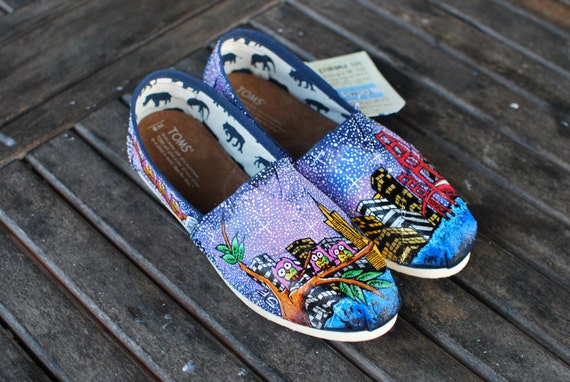
Employees at B Street Shoes custom-painting sneakers at the company's studio in Costa Mesa, Calif. Credit Emily Berl for The New York Times
He had spent an anxious few years navigating the recession and, tired of worrying about when or if he would be laid off, quit his job and started looking for other work. That was when he saw a want ad from the shoe company Toms. It called for an artist to travel to its “Style Your Sole” events at California retailers and paint custom designs on Toms canvas shoes.
Although Mr. Barash has worked in banking, he is also an artist and grew up painting, woodworking and creating ceramics. Even during his time as a credit analyst, he painted names onto his friend’s hats for fun as well as graffiti-style designs. Mr. Barash got the Toms job and a year later, had built a substantial portfolio of custom-painted shoes. He liked doing it so much that he decided to start his own business. In September 2011, he started B Street Shoes on Etsy, which grossed $60,000 in its first year.
According to the market research firm NPD Group, retail sneakers are a $29 billion market in the United States. Customization within the sector is growing, reflecting the demand for one-of-a-kind goods — spurred by millennials on one end and baby boomers on the other, said Elizabeth Spaulding, a retail partner at the consulting firm Bain & Company.

Consumers generally want more control and choice in what they purchase. “There’s been a big push toward customization in many industries,” Ms. Spaulding said, citing as an example the hugely successful restaurant chain Chipotle, where customers build their own meals. “And when you think about the market for sneakers, there is already a heavy emphasis on choice and individualism.”
It has been a perfect storm for Mr. Barash. He says B Street Shoes is now in the top 1 percent of sellers on Etsy (the marketplace would not confirm that, because it does not disclose information about sellers). His store gets more than 140,000 visits a month and is responsible for 60 percent of B Street Shoes’s sales.
Mr. Barash maintains a Facebook page, posts photos daily on his Instagram and Tumblr accounts, and blogs about sneakers on the company’s website, created in 2014. His Instagram account has around 30,000 followers and the company’s Facebook page has more than 21,000 “likes.”
From 30 to 50 percent of B Street Shoes traffic is directed there via curated shopping sites like Pinterest or Wanelo (for “Want, Need, Love”). Those sites drive traffic to Mr. Barash because users pin or post photos of their shoes for their followers to see. More than half of B Street Shoes customers are women, allowing Mr. Barash to tap into a surprising market for a sneaker customizer: brides. To promote that part of his business, Mr. Barash blogs about wedding shoes on his site and writes guest posts, or is quoted as an expert, on wedding-related blogs.

A pair of Vans sneakers from B Street Shoes. The average price per pair is $200. Credit Emily Berl for The New York Times
Heather Lynch ordered a pair of custom Vans from B Street Shoes for her wedding this fall in suburban Nashville. She had been looking for flats to wear when she saw a pair of custom Keds on the B Street Shoes Etsy store that had been designed for a wedding. “It’s important to me to have a wedding that’s unique,” she said. “And I thought that was the coolest idea ever.” Ms. Lynch ordered a pair of Vans that incorporated her wedding colors (coral and navy), flowers (Gerber daisies) and a painting of headphones, as music is something that drew Ms. Lynch and her fiancé together.
Mr. Barash is following in the footsteps of other artists operating in this footwear industry niche who do little, if any, paid advertising, instead marketing themselves heavily through social media. This has changed the landscape for small companies that customize, allowing them to compete with big brands like Nike that do large-scale, machine customization, said Ben Ewy, a sneaker collector who teaches the course “Streets Is Watching: Innovation in Sneaker Culture” at Buffalo State College.
The artist and designer Dan Gamache started Mache Custom Kicks in Connecticut as a side job a decade ago but has been able to work at it full time for the last four years thanks in large part to Instagram. “It has been a huge tool; it thrust me out into an audience who would never have known who I was,” Mr. Gamache said. “I have half a million followers.” There is a five- to six-month wait for his custom shoes, which range in price from about $300 to $1,000.
Although custom shoes are just a small fraction of the resale sneaker market, in 2012 — when Facebook bought Instagram — the number of small businesses selling customized and collectible sneakers started growing at a much faster rate than before, said Josh Luber, founder and chief executive of Campless, a data company that tracks the sneaker resale market. “Many people have created businesses selling sneakers directly on Instagram,” Mr. Luber said. He estimates the resale market is worth, conservatively, $1 billion.
Jacob Ferrato, owner of JBF Customs in Cleveland, started customizing athletic shoes eight years ago, when he was 16. He no longer paints them but rebuilds them with high-end exotic leathers like ostrich, python and alligator, and just introduced his own line of custom-built sneakers. Mr. Ferrato’s shoes start at $1,000, and clients have paid as much as $7,000 for a pair. He does no advertising, but has 120,000 followers on Instagram. That, along with Facebook and Twitter, is his marketing. “I’ve grown because of people talking about me on social media — that’s been everything. And the fact there are so few things you can buy that are truly unique,” he said. “People just want something no one else has.”


Comments
Post a Comment